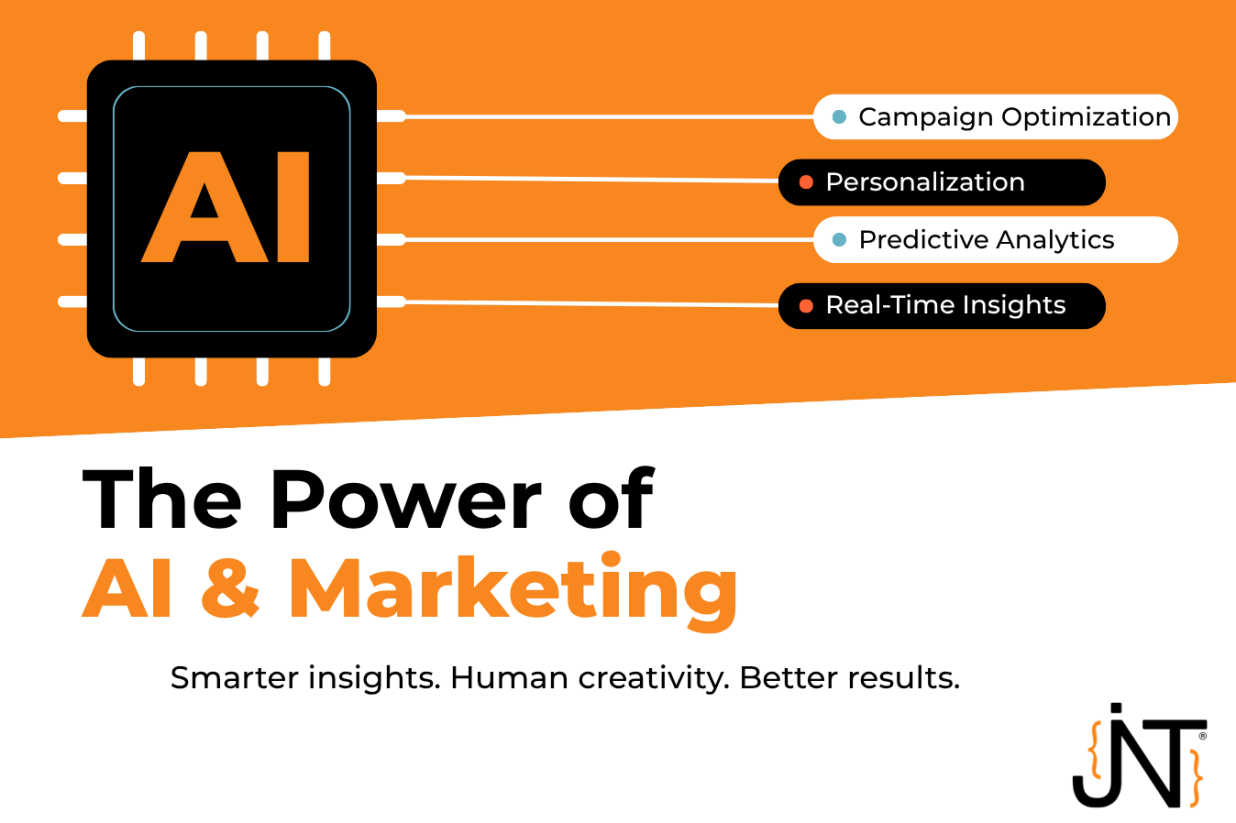
The Power of AI & Marketing
27 October 2026
The Power of AI & Marketing
Artificial intelligence (AI) is rapidly transforming the marketing landscape, giving businesses new ways to connect with customers, streamline operations, and make data-driven decisions. What once required hours of manual analysis can now be accomplished in minutes through AI-powered tools that process large volumes of customer data, identify trends, and uncover valuable insights. From audience segmentation to campaign optimization, AI enables marketers to work more efficiently while delivering more relevant and personalized experiences to their target audiences.
One of AI’s greatest strengths is its ability to enhance personalization at scale. Today’s consumers expect brands to understand their preferences and provide content that aligns with their interests. AI helps make this possible by analyzing customer behavior, purchase history, and engagement patterns to deliver tailored recommendations, targeted advertisements, and customized messaging. According to research from IBM, AI-driven marketing automation allows businesses to continuously optimize campaigns and improve customer experiences through real-time decision-making and predictive analytics. Additionally, Salesforce reports that a significant majority of marketing organizations now utilize AI to support activities such as content personalization, performance forecasting, and customer engagement. These capabilities help businesses build stronger relationships with their audiences while maximizing marketing effectiveness.
How Marketers Are Putting AI to Work
So what does this look like day to day? Here are some of the most practical ways businesses are using AI right now.
-
Content brainstorming and first drafts. Staring at a blank page is one of the biggest time-drains in marketing. AI tools can generate blog topic ideas, outline articles, suggest headlines, or produce a rough first draft of social captions, giving writers a starting point they can then shape, fact-check, and refine.
-
Email marketing. AI can help write and test subject lines, determine the best time to send to each subscriber, and segment lists based on how people actually engage, so a customer who clicks every product update gets different messaging than one who only opens seasonal promotions.
-
Paid advertising. Platforms like Google Ads and Meta use AI to automatically adjust bids, test ad variations, and find audiences most likely to convert. Marketers set the goals and budget, and the system continually optimizes toward them.
-
SEO and search visibility. AI tools can identify keyword opportunities, flag content gaps compared to competitors, and suggest improvements to existing pages. As more people use AI-powered search and chat tools to find answers, structuring content clearly so it can be understood and cited is becoming just as important as traditional rankings.
-
Customer service and chatbots. AI chat assistants can answer common questions around the clock, route more complex requests to the right person, and capture leads after hours, freeing up staff for conversations that need a human touch.
-
Analytics and reporting. Instead of manually pulling numbers from multiple platforms, AI can summarize campaign performance, spot unusual dips or spikes, and highlight which channels are driving results, making it easier to decide where to invest next.
-
Visual and video content. AI can resize graphics for different platforms, remove backgrounds, generate captions and transcripts for videos, and help create quick concept mockups before a designer takes over.
What Not to Do
AI is a powerful tool, but it’s easy to misuse. A few pitfalls to avoid:
-
Don’t publish without reviewing. AI can confidently produce information that’s outdated or simply wrong. Every statistic, claim, and source should be verified by a person before it goes live.
-
Don’t let it erase your brand voice. Unedited AI content tends to sound generic. If your blog posts and social media start sounding like everyone else’s, you lose what makes your brand memorable.
-
Don’t rely on AI-generated graphics as your final design. AI images are easy to spot: overly polished lighting, warped details, and that same glossy, generic look showing up everywhere. Your visuals should reflect your brand’s colors, style, and personality, not a standard AI aesthetic. Use AI for quick concepts or production tasks like resizing, but leave the finalized design to a designer who knows your brand.
-
Don’t feed it sensitive information. Be careful about entering customer data, financial details, or confidential business information into public AI tools. Know where your data goes and follow your company’s privacy policies.
-
Don’t automate the relationship. A chatbot can answer “What are your hours?” but it shouldn’t handle an upset customer or a complex sales conversation alone. Make sure there’s always an easy path to a real person.
-
Don’t chase volume over value. AI makes it easy to produce lots of content quickly, but more isn’t always better. Search engines and audiences alike reward content that’s genuinely helpful, not content that exists just to fill a calendar.
-
Don’t set it and forget it. Automated ad campaigns and AI-driven recommendations still need regular check-ins. Algorithms optimize toward the goals you give them, so if those goals are off, the results will be too.
Finding the Right Balance
While AI is a powerful tool, it is most effective when paired with human creativity and strategic thinking. Successful marketing still depends on understanding customer needs, telling compelling stories, and building authentic brand connections. AI can provide the insights and efficiencies needed to support these efforts, but it cannot replace the human perspective that drives meaningful engagement. As technology continues to evolve, businesses that embrace AI as a complement to their marketing strategy rather than a replacement for it will be better positioned to stay competitive, drive innovation, and deliver exceptional value to their customers.
-Carter Zoeller
Empower 2026 Intern
